Monday, November 7, 2011

4 types of exercise to improve blood circulation of patients with diabetes

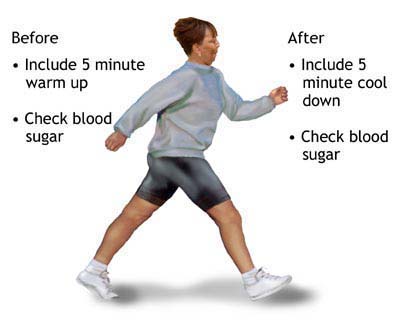
Health Net: Diabetes can cause hardening or narrowing of blood vessels in the leg so that it can lead to poor blood circulation. Poor blood circulation will make you feel cold, heat or pain. There are several exercises that can be done to improve blood circulation in patient’s diabetes.

When poor blood circulation occurs continuously, it is possible that patients with diabetes will experience diabetic foot disorders and increased risk of amputation and even death. Exercise can improve circulation and blood flow to the legs.

Here are some exercises that can improve blood circulation in patients with diabetes, as reported by Livestrong on Tuesday November 8, 2011:

1. Aerobics
American Diabetes Association recommends aerobic exercise as a way to increase blood circulation throughout the body. Form of aerobic exercise that focuses on lower body includes walking, dancing, cycling and swimming.

Do not forget to use comfortable shoes to provide cushioning and support your feet during aerobic exercise, so that spared from cuts and abrasions which can cause infection.

2. Stretching
Stretching tight muscles can reduce stress levels and improve blood circulation throughout the body, according to the Mayo Clinic. American College of Sports Medicine recommends two weekly sessions that combine stretching the major muscles. Extra stretch in the calf ankle and foot can improve circulation negatively affected by diabetes.

3. Rotation of the ankle
Rotation of the ankle can increase blood flow and circulation in the ankle, foot and leg. The trick, sitting in a chair and rest your feet on the ground.

Raise your right leg about 30 cm of soil and movement of the fingers in the direction away from the body. Movement of the big toe forming a large circle to the right. Keep your legs in a stable and allow the ankle and the foot that works. After 10 circles, change direction and do the same with the left foot.


4 types of exercise to improve blood circulation of patients with diabetes

Health Net: Diabetes can cause hardening or narrowing of blood vessels in the leg so that it can lead to poor blood circulation. Poor blood circulation will make you feel cold, heat or pain. There are several exercises that can be done to improve blood circulation in patient’s diabetes.

When poor blood circulation occurs continuously, it is possible that patients with diabetes will experience diabetic foot disorders and increased risk of amputation and even death. Exercise can improve circulation and blood flow to the legs.

Here are some exercises that can improve blood circulation in patients with diabetes, as reported by Livestrong on Tuesday November 8, 2011:

1. Aerobics
American Diabetes Association recommends aerobic exercise as a way to increase blood circulation throughout the body. Form of aerobic exercise that focuses on lower body includes walking, dancing, cycling and swimming.

Do not forget to use comfortable shoes to provide cushioning and support your feet during aerobic exercise, so that spared from cuts and abrasions which can cause infection.

2. Stretching
Stretching tight muscles can reduce stress levels and improve blood circulation throughout the body, according to the Mayo Clinic. American College of Sports Medicine recommends two weekly sessions that combine stretching the major muscles. Extra stretch in the calf ankle and foot can improve circulation negatively affected by diabetes.

3. Rotation of the ankle
Rotation of the ankle can increase blood flow and circulation in the ankle, foot and leg. The trick, sitting in a chair and rest your feet on the ground.

Raise your right leg about 30 cm of soil and movement of the fingers in the direction away from the body. Movement of the big toe forming a large circle to the right. Keep your legs in a stable and allow the ankle and the foot that works. After 10 circles, change direction and do the same with the left foot.


What I'm reading now -- Body Toxic (Nena Baker)


I'm always reading something... I don't always finish what I'm reading but I've probably got 20 books in some stage of absorption right now. I'll continue to blame the chemo for my short attention span... and keep it moving (laughs).

I picked up a copy (picked up being a euphemism for strolled through http://greenhillgoldman.blogspot.com.com) of The Body Toxic:  How the hazardous chemistry of everyday things threatens our health and well-being. And in the first few pages I was smacked dead in the center of my eyes with a whole lot of stuff I wasn't sure I wanted to know. 

I have a personal theory that our world is just so chock full of crap that its slowly killing us. I have no proof for this theory. I have no scientific background which I could point to that says... "you might be right Nicole". No, I have none of that. All I've got is this feeling... and I know that its lame to just have a feeling but eh. Its all I got right now, so I'm going with it.

This well-researched and clearly laid out book actually shows me that my non-scientific feeling could be very dead on. Even as our government agencies slowly do away with certain chemicals, their effects manage to continue to leach into our environment and accumulate in our bodies. The first few pages and chapters of this book are frightening. Clean living, healthy living, being diligent about what you eat, working out and all of that... doesn't stop these toxic chemicals from finding their way into our bodies. Though it can reduce our toxic load. And that is a step in the right direction.

I won't give away all of the great information in this book but if you are remotely concerned about how our environment affects the chemical load in our bodies -- and how that toxicity can affect our health -- please do yourself a favor and pick up this book.

Let me add... it gets a little heavy -- all the names of all of chemicals became a little confusing for me -- but the information is startling. The writer did a great job of providing a good historical background that explains how we got to this place and she offers reasonable suggestions for you to consider if you want to take action steps to lighten your chemical load. She's not suggesting radical life changes... just a few small ones that may help. Things like eating organic foods, no microwave popcorn, and not using plastic in the microwave.

Honestly, chemotherapy has forever changed my perspective about what I put in and on my body. The days immediately following my infusions, I could SMELL the medicine coming out of my skin. I hated that sick smell and I got into the habit of soaking with Epsom salt to draw out toxins during that time in my life. So, the few little changes that she's suggested, are ones that I will be sure to implement. We cannot avoid all of the chemicals in our world. It simply isn't possible. But, if you're like me, any few steps that you can take to regain control (just a little bit) of your life makes a difference in your outlook.

I'll never wear a wedding ring

I call breast cancer the gift that keeps on giving. (laughs) I say that very tongue-in-cheek because I am always finding new surprises around the corner that breast cancer has gifted me with. You know that I wonder about love and dating and marriage a bit... But the other day, in the midst of a conversation with some friends online I had a startling revelation:  I will probably NEVER wear a wedding ring.

*gasp*  Clutch your pearls. Swoon. Faint. Get some smelling salts... did I really say that? Yep. I sure did. But that doesn't mean that I won't fall in love, get engaged or get married... I mean very specifically... I won't wear a wedding ring.

You know how we women get all giddy and giggly at the thought of having the love of our lives gift us with the most perfect expression of his love? How we dream about and drool over these shiny little baubles? Well, I'm not the biggest jewelry lover. I like jewelry, to be honest. But I don't like a lot of jewelry and I'm pretty particular about what makes my heart beat faster and what is just... well, nice but not my taste. So, here's the revelation I had... I have lymphedema. (But you knew that, right?)  And my lymphedema is in my left arm. And lymphedema brings its own challenges (cuz... breast cancer is that gift that keeps on giving)  Some of the challenges are interesting. I have to be very cautious about protecting my arm at all times. I am cautioned to avoid insect bites, bumps, bruises and such. I can't have needles used on that arm. Neither can I have my blood pressure taken with that arm. Those are tolerable nuisances. *though that mosquito avoidance gets real tricky in August*

But guess what else? I can't wear a watch, a bracelet or ... *drum roll*... a doggone RING! So, I'll never get to experience that exhilarating moment when the love of my life presents me with the ultimate gift -- that the whole world is supposed to use as a barometer to measure our love. (laughs -- we are so primitive sometimes)

Honestly though? I just added another line to my list of "it would be nice if he..." qualities that I hope to find in the man I've been waiting for. The new addition to the list is..."it would be nice if he was a creative thinker and could come up with an expression of love other than an engagement ring" because while I'm all about being a rebel and bucking the system... I'd hate to get a ring and never be able to wear it because it aggravated my lymphedema and my fingers swelled up to look like mini bratwursts or something....

Just another day in the life of a sexy, single, childless, still dating (though dating stinks), funny, sensitive breast cancer survivor.  *wink* 

Any suggestions for other ways that my love-to-be can lay claim to me so that the whole world understands that I'm taken? I'm thinking perhaps a lovely necklace or a ring on my right hand. What do you think?

Sunday, November 6, 2011

Cancer Marker Blood Tests

This post is going to deal about cancer marker blood tests, such as lung cancer marker, pancreatic cancer marker. These tests to detect cancer are called specific blood tests, as they reveal the right thing about what type of cancer is. The names of these tests are HCG, PAP, PSA, serum protein electrophoresis,  and serum protein immunoelectrophoresis. Once the physician suspects about a particular cancer type, he will order any of these tests to find the specific sort of cancer. Tumor marker test checks the chemical content in the body to detect the presence of any cancer. We will see more in detail about each test one by one now.


HCG or human chorionic gonadotropin: HCG is a glycoprotein hormone present in the body. This hormone is present in woman during the pregnancy time, which helps in the formation of embryo after pregnancy. This hormone will be in the elevated state in the patients with cancer in the ovary in women or cancer in the testis in men, and also in some types of lung cancers. In general, HCG is in the elevated state during the pregnancy normally other than a patient with cancer.

PAP or Prostatic Acid Phosphatase: The other name of PAP is prostatic specific acid phosphatase or PSAP. PAP or PSAP is a hormone that is produced by the prostate gland. This hormone level will be elevated in the patients with prostate cancer.

PSA or prostate-specific antigen: This is also glycoprotein that is identified in the KLK3 gene. PSA test is helpful in detecting prostate cancer. This test also helpful in deciding what kind of treatment is to be given to the patient too.

SPEP or Serum Protein Electrophoresis: SPEP is visual examination done in the lab to detect the presence of globulins in the blood. Globulins are a specific kind of proteins present in the blood. Blood sample is drawn from the body using a syringe to do this exam. If a patient is affected with multiple myeloma, in that case, this test in the patient will reveal unusual gamma globulin.

Serum Protein Immunoelectrophoresis: This test includes IgG, IgA, and IgM antibodies. This test also helps to detect the presence of kind of unusual or abnormal gamma globluin.

In the next post, we will deal about tumor markers and other blood tests. Okay.


Home Page:

To go to the prior post, please click the link below.
http://greenhillgoldman.blogspot.com/2011/11/cancer-screening-blood-tests.html


Free Medical Transcription Course Blog:


Tags: lung cancer marker, pancreatic cancer marker, cancer marker blood tests, blood test cancer marker, tumor marker for breast cancer, breast cancer tumor marker, colon cancer marker, colorectal cancer marker, cancer marker test, cancer marker tests, cancer marker blood test

Friday, November 4, 2011

Cancer Screening Blood Tests

In the prior post, we have read about nonspecific blooe tests to detect cancer, such alkaline phosphatase, amylase, SGOT, SGPT, LDH, uric acid, creatinine, BUN, calcium, and electrolytes. In this post, we will read about specific blood tests, such as CEA, CA-125, CA-19-9, CA-15-3, CA 27-29, AFP, HCG, PAP, PSA, serum protein electrophoresis, and serum protein immunoelectrophoresis. Now we will see about each test one by one.


CEA: It can be expanded as carcinoembryonic antigen. All human being will have this antigen in low levels in their blood, but cancer patients will have abnormally elevated CEA levels in their blood. Especially patients with lung, breast, colon, pancreas, and rectal cancer patients will have elevated levels of CEA.

CA-125: It can be expanded as cancer antigen 125 or carbohydrate antigen 125. The other name of mucin 16 or MUC16. CA-125 level is normally elevated in the people with overy and uterus cancers.

CA 19-9: This can be expanded as carbohydrate antigen 19-9. The other name is sialylated Lewis antigen or cancer antigen 19-9. Lewis antigen is found in red blood cells. Patients with stomach, colon, pancreas, and liver will have this level increased in their blood.

CA 15-3: This can be expanded as carbohydrate antigen 15-3. The patients who have breast cancer will have CA 15-3 level elevated. It is a tumor marker test for cancer in the breasts. CA 27-29 is also a tumor marker test for the patients with breast cancer.

AFP: This can be extended as alpha-fetoprotein and this is a kind of plasma protein. This is found in the fetus in the serum albumin. Alpha-fetoprotein may be in the elevated condition in the patients with liver cancer and also found in the patients with testis cancer.

In the next post, we will learn about other specific blood tests, such as HCG, PAP, PSA, and serum protein tests. Okay.

Home Page:

To go to the prior post, please click the link below.


Free Medical Transcription Course Blog:


Tags: cancer screening blood tests, blood tests that detect cancer, blood tests to detect cancer, what blood tests detect cancer, blood tests detect cancer, blood tests show cancer, what blood tests show cancer, ovarian cancer blood tests, does cancer show in blood tests, breast cancer blood tests, blood tests for cancer detection

Thursday, November 3, 2011

Liver Disease Symptoms

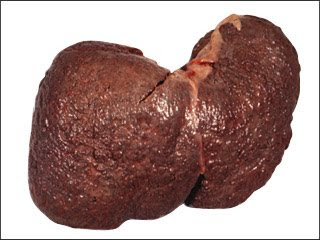
Liver Disease Symptoms, symptom checker, there are many liver diseases along with liver cancer that do not show a lot of symptoms, and it will be terrifically hard for a doctor to detect it if they do not do the requisite amount of tests. One of the symptoms that can actually include liver disease is the swelling of the gallbladder along with the swelling of the liver

Liver Disease Symptoms
something that can actually be very fatal to human body. The symptoms of liver disease can also be a very poor appetite, as the liver which actually consists of the pile which regulates the amount of food intake in her body and is also responsible for the amount of appetite that we have.

The symptom and fallout of liver diseases excessive loss of weight and also the turning of the skin to yellow, along with fever and always being tired. The excessive loss of weight is because of the fact that if you do not feel hungry at any moment of time, then automatic protein level of your body will decrease along with the fat intake of your body, and you would only be breaking down those tough in order to feed your body. This will actually result in the body becoming thin.

More For Liver Disease Symptoms

The main symptom of Liver disease is Jaundice, There are two types of Jaundice as described in the traditional oriental medicine, Yang Jaundice and Yin Jaundice.

Yang Jaundice — Thirst, Palpitations, constipation, urinary problem, abdominal distention as well as yellowing of tongue are the major symptoms of whole body jaundice in which the body color changes to somewhat like fresh tangerine color. According to the oriental medicine, this type of jaundice happens from excessive damp and moist heat.
Yin Jaundice — Your face, skin and eyes all turn yellow. Severe fever, nausea, poor appetite, lassitude, fatigue, abdominal distention, chest repression, loose stools, hypochondriac pain, cold hands and feet, palpitation, edema and breaking breath are all very common symptoms of Yin Jaundice.

Symptoms of Liver Disease

Going by the perspective of oriental medicine there are few other signs or symptoms that indicate the persisting liver problem.

Headache
Problem of skin
Allergy
Feeling of Dizziness
Tinnitus
Ticks, Spasms and Tremors
Sudden Seizures
Stroke
Redness and itchiness of eyes
Short temperedness and constant irritation
Tension and pain in the back
Hypochondriac pain
Loss of flexibility of tendons and ligaments
Depression
Mood Swings

Source : liver-disease-symptoms.com/

Liver Disease Pictures And Images

Liver Disease Liver Disease Picture Liver Disease Pictures Liver Disease Photos