Showing posts with label international. Show all posts

Tuesday, February 9, 2010

How to Help out Haiti in Boston

The mainstream media no longer seems to be showcasing the devastation that is going on in Haiti, but that doesn't mean that the issue has been resolved. Actually far from it, and there are still ways you can help impact the lives of the Haitian Community right here in Boston.

From February 8th -21st several Boston area locations along with FUNTOSALUD International will be collecting donations to help Haiti rebuild. The locations are as follows:
Some of the items they are collecting include:
  • First Aid Supplies
  • NEW underwear
  • Shoes (particularly for children)
  • Baby supplies (bottles, diapers, etc)
  • Batteries
  • Flashlights
  • Tents
  • New Bed Sheets
  • New Towels
  • School supplies (Notebooks, pencils, book-bags, etc.)
  • Personal Hygiene items
Of course you can still make monetary donations or even volunteer directly for the 2010 Border Health/Mission DR/Haiti from April 17-30, 2010. For more information on how to directly volunteer, email volunteer@funtosaludintl.org.


Monday, May 25, 2009

Memorial Day - Tribute to the Troops

No matter your political views, most of us can appreciate the sacrifice individuals make when they volunteer to serve in the US armed forces.

This past March, my boyfriend and I spent two weeks in Honduras to rest, relax, and explore. During our time on Roatan (an island off the coast of Honduras), we met a group of Navy people (sea men?) who had volunteered to help build schools on the island. The Navy also donated $9,000 towards the effort.

Most of the sailors on the ship moored just off the coast of the island chose to rest and relax like Terrence and I did, but it was really touching to see this group of sailors who chose to give up a few days to help build the school, play with the kids, and make a difference in a place where 75% of kids do not attend school.

So on this Memorial Day, I'm saying thanks for the things our armed forces do that are above and beyond protecting us - for reaching out and helping people who really, truly need it. Thank you.

The photo is of laundry drying in a village on Roatan island in Honduras.

Friday, May 8, 2009

Your Name on Toast

Yep not kidding.  You can have your name or web address written on toast for any amount of donation (min $100.00) to Oxfam-Ireland. If you click on any of the pieces of toast then it links you to the website of the doner.  

The next logical question is why?  Well the obvious answer to that is who doesn't love toast and who wouldn't want to see their name on toast?

The website claims it's a silly idea, but silly ideas get people talking and creates awareness of the cause you are trying to promote.  SO TRUE!  This is why I
 loved watching Chicago station Channel 9 news in the morning growing up because they would make people do silly things, like be a human bowling ball and they would give you a bit of air time to promote your cause.  If hurling myself down a bowling lane to knock down some pins helps end world poverty than I am in!

I would also like to point out that they have raised over $11,000.00 to help Oxfam-Ireland thus far!   Think of what a unique mother's day gift it could be to, her name on toast.  

Click here to buy your own toast.
Click here to see all the pieces of toast that have been written on.


Picture Courtesy of: http://yournameontoast.com/

P.S. Thanks for the idea Casey

Tuesday, February 24, 2009

Food is key to culture

I spent this past weekend in Nashville, TN (congrats, Eric & Leah!), and while waiting for my boyfriend to finish tying his tie (first too short, then too long), I caught a little of Anthony Bourdain's show No Reservations on the Travel Channel. For those of you unfamiliar with Chef Bourdain and his show, he travels all over the world sampling each regions' foods, whether it be cow intestines, deep fried chicken, or clam chowder. He tries it all.

It struck a chord with me as I prepare for my 12 day vacation in Honduras - really, the way to get to know a country is to eat its food. You can learn so much. After all, food is what we all have in common - we need to eat to survive.

My co-worker went to India for a wedding a few years ago, and only ate rice and naan for fear of getting sick. I went to India shortly after her, and my favorite part of the trip was trying different foods. I'll never forget sitting in the roadstop restaurant (essentially fast food) with all the hub-bub around my mom and me, and not knowing how to properly eat the meal served to us on a banana leaf.

All the waiters and bus boys stared at us, and finally one kind woman who spoke English explained how to eat the thali properly. (You have to mix the rice with each of the five sauces in a different order and pick it up with your right hand to eat - see the photo of my Mom to the left.) We learned that food in India is more than just nourishment - it's tradition going back hundreds of years.

Food can also bridge cultural gaps. On this same trip to India, my mother and I invited our taxi driver Nathan to have lunch with us. He was so touched by this that he invited my mom and I back to his home at the end of the day tour to have tea and meet his family. They lived in a one room cement dwelling with a common bathroom, and all slept on mats on the floor. We shared more than just tea - we talked about our families, how Nathan wanted to expand his taxi business, and Indian culture in general. We learned so much more than we would have without the visit, and it's just because we broke bread (or naan in this case) together.

My favorite time spent in my semesters abroad in Spain and Nicaragua were sitting with my host mothers/sisters while they prepared meals. The casual conversation we shared taught me what it was really like to live in each place, not just visit it. And that's part of the reason we travel, yes? Not just to see new sights or recline on a beach, but to understand what it's like to live somewhere else, or be someone else.

In these tough economic times, it might be hard to take an international trip. However, that shouldn't stop you from trying new cultures. Chinatown is just a few subway stops away. The North End too. I'm sure you have friends whose families still hold onto their "ethnic" heritages, or maybe you can make a new friend - my office frequently has visiting staff members from abroad.

The point is, food is more than just nourishment - it's a way to learn about something outside of yourself. Perhaps if all of our world leaders broke bread together, we'd all get along just a little bit better.

Nathan, his wife, and his youngest son, who is making a goofy face at the flash.

Related Posts: India Vogue: The haves and the have nots; 10,000 reasons to buy; Food Banks and Food Pantries in Massachusetts; Patio gardens & City growing; Find local food locally; Fruit in the city
Photos are from my trip to India.

Monday, December 1, 2008

World AIDS Day - How to celebrate

Today is World AIDS Day.

Why should you care?

Well, according to the Centers for Disease Control, at the end of 2003, an estimated 1,039,000 to 1,185,000 persons in the United States were living with HIV/AIDS, with 24%-27% undiagnosed and unaware of their HIV infection. The CDC estimated that approximately 56,300 people were newly infected with HIV in 2006 (the most recent year that data are available).

This means one of your partners could have HIV/AIDS and not know it, putting you at risk.

And the US population with HIV/AIDS is minuscule compared to the rest of the world. More than 25 million people have died of AIDS since 1981. Africa has 11.6 million AIDS orphans. And at the end of 2007, women accounted for 50% of all adults living with HIV worldwide, and for 59% in sub-Saharan Africa.*

What can you do about it?

1. Be safe. Have safe sex (read: condoms, folks), and if you're frequently using needles, make sure they're clean.

2. Donate money to the Boston Living Center, the AIDS Action Committee of Massachusetts, or the International AIDS Vaccine Initiative.

3. Volunteer locally in Boston at the AIDS Action Committee of Massachusetts or at the Boston Living Center. Volunteering internationally is always an option too!

4. Attend one of the Boston area World AIDS Day events, including a memorial service at the Boston Living Center; a talk at the MIT Museum entitled "AIDS: When will it end?"; or a chamber concert benefiting the AIDS Action Committee.

Either way, it's time to take action.


Related Posts: World AIDS Day 2007; 2009 Calendar Benefiting Indian Women; What to ask before you commit to volunteering; International Volunteering; Earthquake in China Volunteer Opportunities
*Stats taken from http://www.avert.org/worldstats.htm.

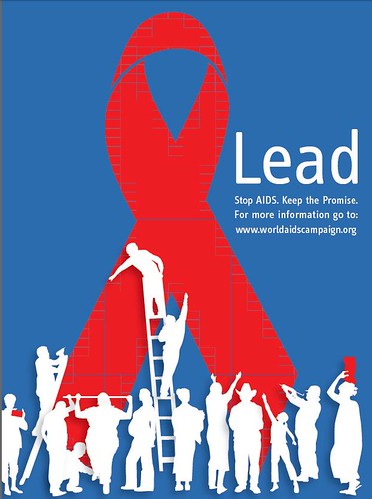
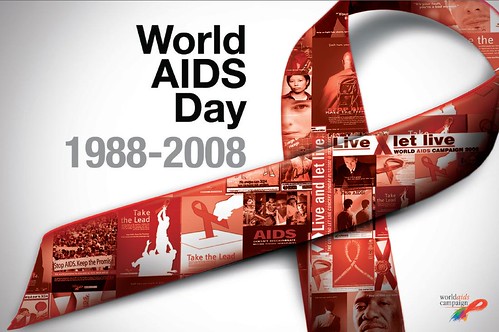
Images courtesy of WorldAidsCampaign.org.

Thursday, October 9, 2008

2009 Calendar Benefiting Indian Women

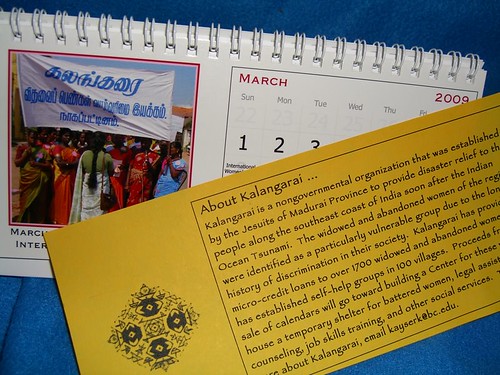
We're always talking about how you can help save the world, even in small ways. My friend Chelsea went to India with her grad school classmates last year. Her group worked with a group in Madurai province called Kalangarai, which was created shortly after the Indian Ocean tsunami in 2004 to help widowed and abandoned women. To date, Kalangarai has provided over 1,700 micro-credit loans to women so they can start businesses and started self help groups in 100 villages.

Chelsea says, "We worked mostly with widows and abandoned women, who are considered by Indian society as unworthy and are discriminated against on a daily basis. These women are living in conditions that are unimaginable to the likes of us Westerners.

"They are not only struggling with providing for their families but they are faced with brutal physical, verbal and sexual abuse at the hands of people that live alongside them in their villages. They are shunned and made to feel inhuman.

"I was struck with disbelief and grief when I heard of what these women faced every day. Despite all this, they showed so much strength and determination to survive in this hostile environment. I knew I needed to do something to help."

So Chelsea and her peers created a small 2009 desk calendar with photos from their trip and information about Kalangarai, and are selling it for just $10 (see photos of the 2009 calendar below). All proceeds are going to help build a center for the women where they can obtain legal assistance, counseling, job skills, and temporary shelter.

If you'd like to purchase a calendar (or three) from Chelsea, just email her at Chelsea Lettieri at gmail dot com to set up a time to meet and exchange the funds for the calendars. If you don't live in Boston, I'm sure she knows how to use the lovely United States Postal Service. Don't worry, she's trustworthy. I can personally vouch for her, if that means anything. :-)

The 2009 desk calendar!

Related Posts: India: The haves and the have-nots; Giving away $80K; Who is happier?; International volunteering for teens

Photos courtesy of me. I bought three calendars! To see more photos of my own trip to India, visit my India web album.

Monday, September 29, 2008

Disasters, Crises, and Donating Blood

Often times during crises, we feel helpless. We want do something, not just sit watching, or give money. It all feels too ineffective. I can't tell you how many emails OYFP received asking how to volunteer in China earthquakes in China earlier this year... but I didn't have anything to tell the people who contacted us, other than to direct them to other organizations.

This feeling of helplessness when witnessing other people's pain and suffering is not a pleasant one. Sometimes people even feel guilty for not being hurt - especially during 9/11. What I find interesting is that the Red Cross has found a way to take advantage of this feeling. Whenever there's a crisis, the Red Cross runs ads along the lines of, "You can help. Give blood today, and ease the suffering of the people in China/Indonesia/Louisiana/New York City/Galvaston, TX."

Do you think your blood actually goes to those places? In most cases, probably not. But the Red Cross is able to sell the blood to hospitals that badly need it for those small every day crises - car crashes, train accidents, house fires, etc - and use that money to help in the larger disasters.

The Red Cross has found a way to let people help - and it's more than just giving money, or donating clothes. You give a piece of yourself- literally. So though I think the ads are a little misleading, I still think everyone ends up winning. The Red Cross helps people, and you feel like you did something to make a difference.

If you're interested in donating blood, look on the Give Life blood donation website. You can also read a list of blood donor guidelines.

Related Posts: An Olympic Debate; Earthquake in China; Global Volunteering; Tornadoes, Cyclones, and Disaster Relief; Champions of a Cause
Photo courtesy of cayusa.

Monday, August 25, 2008

Fish out of water - My experience in Nicaragua

While cleaning out my computer's hard drive the other day, I came across this essay I wrote about my experience volunteering in Nicaragua with the Foundation for Sustainable Development. Unlike most "volunteer" programs, you are actually expected to do work, and since I had a bachelor's degree in psychology, I was a psychologist!

More difficult than the work, however, was fitting in. This essay discusses how I finally managed to do that.

- - - - - - - - - - - - - - - - - - - - - - - - - - - - - -

I am 5’9”, blond, and have blue eyes. I could not look more different than Nicaraguans. The average Nicaraguan woman is 5’2”, brunette, and somewhat rotund from the deep-fried foods that are consumed with abandon. The average Nicaraguan man can’t be taller than 5’5”!

During my four month stay in Nicaragua, I could not have become more painfully aware of these simple physical differences. However, I found that the barrier to “fitting in” wasn’t the presence of the physical differences, it was my attitude towards them. I had to accept that I was different and acknowledge that I would never be able to camouflage myself. Only then was I able to feel and act like I really belonged.

The first few days in Nicaragua were the hardest. I was literally a fish out of water, tossed into a hot, dry, and worn-out land when I was used to a cool, placid, and plentiful ocean. Every molecule in my body screamed to be back where I could breathe! My previous world, the one where all of my friends and family still lived, seemed incredibly and unbearably far away.

After my vision cleared and I learned how to breathe, it became evident exactly how different I appeared. The people of Nicaragua (men especially) did their part to remind me as well. “Hey muñeca.. chela… ¿que pasa?” [Trans.: Hey doll.. whitey.. what’s up?]

Everywhere I went, people pointed and commented. More than once, children poked or slapped any part of my body that they could reach, to see if the “doll” was real. With all of these constant reminders, how could I help but concentrate on how different I was than “those people”?

Spending time with Aimee, a tall, blond Peace Corps volunteer who had been living in Nicaragua for over a year, helped me both acknowledge and accept my physical differences. She had learned to laugh, saying “When the two of us living, breathing muñecas walk down the street together, they just don’t know what to make of it! We’re unbelievable!” At that point, I spoke Spanish like a native Nicaraguan. I was so brown I looked like a sorority girl who had fallen asleep on her tanning bed. But I was never going to look like I belonged.

Looking back on my trip, I realize that this was the turning point. After I accepted my physical differences, I made a few Nicaraguan friends. More than one told me, “You’re different than the other gringos. You speak, you listen, and you understand.” We talked about music, parents, favorite foods, best friends, and what exactly the mayor was thinking when he proposed dumping the city’s trash in the nearby volcanic crater.

I will never take for granted how much easier life is when you physically fit in. I will never forget that in order become part of a culture different than your own, you must acknowledge that you are a fish and everyone else a mammal.

This is not exclusionary, pessimistic, or close-minded.

Robert Reich, who at 4’9” is one of the shortest politicians out there, starts every speech with a joke about his height. By acknowledging his physical difference, he makes it possible for everyone to stop concentrating on his stature and start concentrating on what he has to say.

Once you get the elephant in the room out of the way, it is possible to start forging friendships, really learning what it’s like to live within the new culture, and creating an experience that you will never forget.

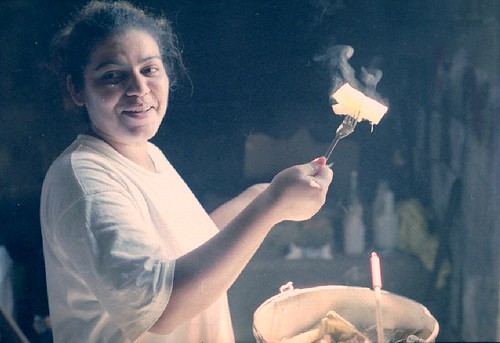
Nora, Aimee (the Peace Corps volunteer) and two of her friends at a park in Granada. The photo is a scanned in negative because back in 2003 I didn't have a digital camera.

Related Posts: International volunteering for teens; Food prices are rising; Chinese Earthquake - How to help; Global volunteering; Gap Year

Photos courtesy of Casey.

Monday, August 18, 2008

International volunteering for teens

It all started in 5th grade with my project on Japan. Each of us chose a different country, and we had to make little paper dolls dressed in that country's "traditional" clothing. I was obsessed with Japan - perhaps it was because it seemed so different than my own family and town, which was mostly blond and brunettes, all living in a suburban Boston wonderland.

That obesssion let me to call the number broadcase on Kiss 108: "Do you want to host a Japanese exchange student?"

Why yes, yes I did! No matter I was only in 5th grade.

I think my mom figured "what's one more kid when I already have four?" and a few months later, we welcomed Tomoko into our lives for a month. A year later, we used my dad's frequent flier miles and at 14 years old, I traveled over to Japan alone to visit Tomo and her family.

Since then, some of the highlights of my travels have included a college semester in Spain, being a psychologist in Nicaragua, and traveling around southern India. Apparently, however, kids are not only traveling around the world and doing it at a younger age than ever, they are starting humanitarian volunteering trips before they've even gone to their Junior year high school prom.

Apparently the increase in high school humanitarian trips is not entirely due to an outpouring of good feelings. Parents are encouraging their kids to go on these trips so they have material for a good college essay. Hopefully their essays end up coming from genuine emotion because then we have a win-win situation: the kid learns something that can't be taught in the classroom, and gets into a good school.

However, in yet another example of the increasing class divide, middle and lower class families may not be able to give these kinds of trips to their kids. Hopefully they'll be able to find fodder for their college essays closer to home - after all, volunteer opportunities for persistent and non-commitment-phobe teens are abound.

If you're interested in getting your teen volunteering, send them to the following websites to investigate:
Keep in mind that the organization is more likely to take your requests for information seriously if the teen calls or emails him or herself. S/he will probably feel more invested in it as well. With a little effort, you (or the teen you know) can have a great volunteer experience and some valuable fodder for that college application essay.

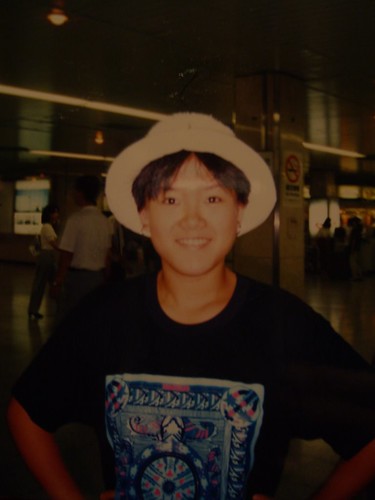
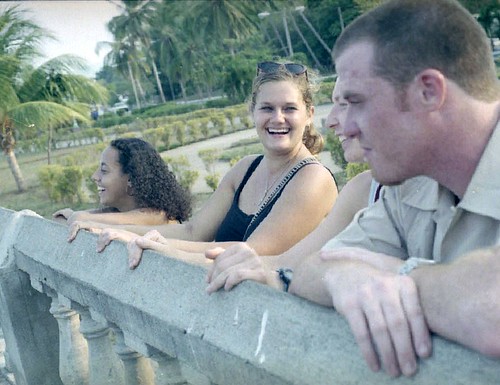
Me, at age 14 in Japan. The yukata was actually crossed incorrectly in the front in the way it is done for someone who has died. Tomoko's friend's mother took me into a phone booth and re-wrapped it for me because I was not, in fact, dead. Letters to my mother about the experience included, "it's hard to walk in those things," "I'm taller than everyone," and "they LOVE firecrackers and sparklers here."
Photos courtesy of Casey.
Thursday, July 31, 2008

Boston Bike Sharing

Boston is considering its very own European-style bike sharing program. For those who are not familiar with idea of Bike-Sharing, it all the rage in Paris with a program called Vélib’s. It's seems to be almost like a Zip-Car option for bicycles.

Wow! What an interesting idea, paying per use bicycles. It's not the expensive, so everyone can afford them and with the rising costs of gas, I can see how it would be popular in Boston. To encourage people to return bikes quickly, rental rates rise the longer the bikes are out.


In Paris, for instance, renting a bike will be free for the first 30 minutes, $1.30 for the next 30 minutes. A two-hour bike rental will set you about $9.10, a two hour drive on the highway with an average four-door sedan would cost you around $20.00 with today's gas prices. That's DOUBLE the price, so you will be saving lots of mula and of course have the added benefit of getting yourself in shape!

I do realize that buying a bike would be probably cheaper overall then renting one over a period of time, but for those who don't own one nor have the necessary funds up front to buy a bicycle it's a great idea.

Related Posts: Biking to Work in Boston - My first time; Bikes Not Bombs Biking in place gets the homeless far

Photo Courtesy of: http://www.metaefficient.com/

Monday, July 28, 2008

Saving Face vs. Smoking

I have written before about how important it is to consider other people's cultural views while traveling or working. These little actions you do are truly critical when creating a relationship with someone else who comes from a different culture than you. It also allows you the opportunity to "save face", or in other words maintain a good self-image while in the presence of others.

I recently read an article by Andrew Jacobs that talked about the popularity of smoking amongst the Chinese people. In fact, Mr. Jacobs, sites that on average "One in four Chinese people smoke, doctors light up in hospital hallways and health ministers puff away during meetings."

It was a bit of a culture shock for me considering I was brought up with the thought process that smoking was harmful and can kill you. That kind of reaction is exactly why the Chinese Government is putting a ban on cigarettes in railway stations, and other public places. They are doing this so that all the visitors coming to the country for the upcoming Olympic Games will be able to enjoy the games “smoke free”.

However, because it is so prevalent in the Chinese society the government is having a hard time curbing it's peoples current smoking patterns. Mr. Jacobs sites that a manager of a popular restaurant in Beijing has stated that he won't ask his customers to not smoke because, "My customers would rather starve than not smoke".

So what do you do if you are going to be going to China in a couple of weeks. Do you refuse a cigarette if someone offers you one? Can't, because you would loose face and loose any availability to create a relationship. Do you do something that you may be personally against? Not necessarily, you can always take the cigarette and throw it out later.

It will be a culture shock certainly for foreign travelers who are used to smoke free public places and it will be interesting to see what becomes of it during the Olympics. After all little actions can have a BIG impact when two different cultures come into play.


Wednesday, July 16, 2008

Olympics 2008: Inspiration. No, really.

It's easy to feel removed from the Olympics. After all, they're happening on the other side of the world in Beijing, China. We've discussed the politics surrounding the Olympics, and current events in China like the recent earthquake, but it still doesn't make it [China] real to me.

I honestly don't know that I'll ever really "get" China or even be able to picture it unless I go there, but after my recent trip to the Olympics training center in Colorado Springs, I can picture the Olympics.

Ok, maybe that's even a stretch - but after seeing the introductory video profiling Olympians going to the 2008 Olympics, I feel the Olympics. I want to watch these young athletes compete with their peers across the world. They're working so hard, they're so dedicated, they've given up so much, and what they produce can perhaps be considered art. Watching someone who is excellent at their job is a joy.

It helps that our tour guide was my cousin Kevin Barnett, who was a two time Olympian on the US volleyball team. He is passionate about the competition, the athletes, and the spirit of the event. In fact, he's a commentator for NBC for the Games, specifically the games of volleyball.

The Olympics begin on August 8, 2008 (08/08/08). Watch on your television, or get it on demand on your computer. According to Kevin, you can watch more than one event at once! Ah, the wonders of the world wide interweb.

This is your chance to see people from all over the world, to feel that spirit of togetherness, and to see art in action. Inspire yourself.

My brother Noah showing his excitement about Kevin Barnett's impending tour of the Colorado Springs training center

Related Posts: Olympics in China - Has anything really changed?; An Olympic Debate; Earthquake in China; Chinese Earthquake: How to Help

Photos courtesy of my trip to Colorado this past weekend. Congrats go out to my cousin Keith and his new wife Jessica!

Wednesday, June 18, 2008

Get Konnected! - Free Networking Event

'Get Konnected!' at a free networking event, hosted by Kaleidoscope, on Tuesday, June 24th from 6:30pm to 9:30pm at 28 Degrees, located at One Appleton Street in the South End.

The event will feature complimentary hors d'ouevres, a live performance by Bongo Love and a cash bar.


Bongo Love is a pop band straight from Zimbabwe, Africa featuring four young talented musicians that have taken Africa and the world by storm, captivating their audience with their afrocoustics that fuse Zimbabwean beats with music from around the world. Bongo Love performed as guest artists at three SOLD OUT shows in 2007 at Madison Square Garden.”


“The mission of 'Get Konnected!' is to provide an ongoing opportunity for cross-cultural and cross-generational networking around professional and personal interests. Get Konnected will achieve its mission by organizing formal and informal, creative programs, forums and activities.”


RSVP by calling 617-357-5777 or email konnected@kscopecity।com. This event is free and open to all.

Related Posts: Non-Profit Networking Aug 13;
Boston Non-profit Networking and Blogging; Good2Gether; Creating your own online community; Social Networking: Is it here to stay?; Get Konnected

Thursday, June 12, 2008

Food prices are rising - Here's how to keep your dough

Food prices are clearly rising, and people all over the world are going hungry. People in Haiti are even eating yellow mud patties just to put something in their stomach.

Want to know something even more depressing? Americans waste 27% of food ready for consumption.* That means almost a third of food that is fit to be eaten is not actually consumed. This included food thrown away in homes, restaurants, and grocery stores - anywhere food ingredients are up for sale.

98% of this discarded food ends up in landfills - the other 2% I suppose is composted or fed to animals.

A 1997 study by the USDA showed that over 96 billion pounds of the 365 billion pounds of edible food in the USA was thrown out.*

So. You want to make a difference? CLEAN YOUR PLATE. Your momma was right - there are starving children in China. And Haiti. And Darfur. And right in your backyard - the good ole U S of A.


Related Posts: Food for Thought; Increasing Food Costs: A New Model; Help Burma by Eating; A Creeping Problem

*According to a recent government story covered in the New York Times.
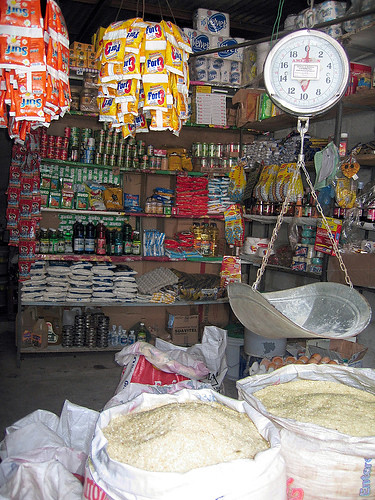
Photo courtesy of BirdFarm. It is of a market in Managua, Nicaragua.

Wednesday, June 11, 2008

Sudan-Reach UPDATE – Violence Erupts in Once Peaceful Capital City, Khartoum

In March, I interviewed Laura who (at the time) was planning a trip to the Sudan to volunteer with the Sudan-Reach Women's Foundation.

The Sudan-Reach Women's Foundation is a Cambridge, Massachusetts-based non-profit organization that, according to their website, helps "Sudanese women and girls realize their highest potential for personal and social growth through self-empowerment, education, and self-sufficiency. Our goal is to promote positive change in women's lives and enhance the communities in which they live."

Laura recently sent me an update about her trip. Here it is:

“Due to the recent outbreak of violence in Khartoum, the capital of Sudan, we at the Sudan-Reach Women's Foundation were forced to cancel our two week volunteer trip scheduled to leave last Saturday, May 17th.

"The surprise attack occurred on May 10th and 11th and was launched by the Darfur rebel group Justice and Equality Movement (JEM). It is estimated that at least 200 people, including civilians, were killed in the attack.

"Although many assume that all of Sudan has been engulfed by the violence in Darfur and Southern Sudan, this attack was the first time in decades the fighting had spread as far as Khartoum, which lies in the Northern region of Sudan. Khartoum has long been considered one of the safest cities in Africa despite the wars that have raged in the outlying Western and Southern regions for many years.

"Loloa Ibrahim (the Director of Sudan-Reach) and I were shocked and saddened to hear the news that Khartoum had been attacked. Loloa grew up in Khartoum and was understandably in disbelief that the peaceful city of her childhood had become yet another battleground for Sudanese conflict. We read every news update we could find about the attack, which received little informative news coverage due to the Sudanese government's severe press restrictions, and waited for updates from Loloa's relatives and friends in Khartoum.

"Most of the fighting occurred in Omdurman, a suburb of Khartoum, where the majority of our volunteer work was to take place. It quickly became clear to us that the situation was still too volatile and unpredictable for ourselves and our volunteers to travel to Khartoum safely. After much deliberation and at the advice of our contacts in Khartoum, we made the difficult decision to postpone the trip.

"Despite this setback, we still plan on taking our group of volunteers to Khartoum at some point in the near future. This will most likely happen in January of 2009, although there is a chance it could happen sooner. We'd like to thank everyone who supported our trip these past few months. Without the support of our local community, the work we do at Sudan-Reach would not be possible.

"Feel free to check our website frequently for updates on the status of the trip as well as local events and programs.”

Thank you for the update Laura, this is unfortunate news.

This outbreak of violence in the once peaceful capital city of Khartoum is a prime example of how volatile the entire county is, as well as a testament to the need and continued support of organizations like the Sudan-Reach Women's Foundation.

Monday, June 9, 2008

Increasing Food Costs: A new model

News reports about the increasing costs of food are appearing daily. According to the USDA, the main factors behind higher food commodity costs include stronger global demand for food, increased U.S. agricultural exports resulting from stronger demand and a weaker dollar, weather-related production problems in some areas of the world, and increased use of some food commodities, such as corn, for bioenergy uses.

According to that same USDA report, eggs have increased in price by 30.5% compared to last year, bananas are up 20% (though still the cheapest fresh fruit by far IMHO), cereals and bakery products have risen 8.9%. Surprisingly meat prices have remained fairly steady, though the USDA credits that to a strong short term stock.

I'm pretty lucky in that I have a good job and little debt. I can afford the increasing cost of food for the most part. And besides, I like to cook, and the food that's increasing the most in price is prepared food because the producers are passing on the increases in food prices plus a surcharge.

That doesn't mean that all of us can afford the increasing costs. According to Second Harvest, visits to food banks around the US have increased 20% compared to last year. There are more than 1.3 million new registrants for food stamps compared to last year.

There are some new approaches to addressing hunger that I learned about on NPR's Weekend America. A few restaurants around the country are charging just what customers can afford to pay. That's right, you choose what to pay for the food you receive. If you can't afford to pay $5 for the cup of soup, put a dollar in the donation box. Yes, you could game the system. But most people don't.

A few examples are the So All May Eat Cafe in Denver, CO; One World Everybody Eats in Salt Lake City, UT; and Terrra Bite Cafe in Kirkland, WA.

I like the idea. It's not a straight up charity asking for donations to alleviate hunger. There's more of a relationship with the community, attracting people of all income levels. They come back for the tasty food, for the feeling, or just because it's there.

I haven't heard of anything like this around Boston.. though I certainly think there would be a market for it. If you want to volunteer or visit food banks, try the following:
And if you're lucky enough to have food on your plate, be thankful and appreciate it.


Related Posts: Food for Thought; Get on the Seoul Train; Water Water Everywhere; One little drip
Photos courtesy of me (Casey) and meals at my mom's house.

Friday, June 6, 2008

A Creeping Problem

Water is an important resource, to say the least. The lack of availability to certain countries continues to be one of the leading environmental issues this year. Traditionally the countries that have a lack of water resources are developing countries. These countries typically do not have the infrastructure to support the water needs of the people living within their borders.

But now because of global warming, lack of water is affecting affluent areas such as the southern coast of Spain where the land has now become a creeping desert.

Worldwide, the United Nations estimates that creeping deserts due to global climate changes may eventually drive 135 million people off their land. Imagine almost half of the people in the US losing their lands due to the land becoming unlivable due to desert conditions.

Additionally, land you used to think of as lush with vegetation have now been reduced to crops of olives and figs which require less water and aren't as sensitive to climate changes. If there isn't enough water to grow crops that use a lot of water, such as corn, then the food shortage issue is unlikely to go away.

Casey wrote about how important it is to reduce your water at home, and I couldn't agree more. There are 100's of ways to reduce your intake of water including taking a shorter shower. This small impact can have a global impact if everyone did their small part.

Related posts: Water, Water Everywhere, One Little Drip of Water, Food for Thought

Photo Courtesy of cbs.news

Thursday, June 5, 2008

Olympics in China - Has anything really changed?

With the recent earthquake in China, the Chinese government has had a respite from criticism around the Tibet issue. Instead, the focus has rightly been on helping those people in immediate need. (And in immediate need they still are.) China has been unusually open in the aftermath of the earthquake, allowing journalists to access many of the regions, and welcoming foreign aid unlike Myanmar.

However, that does not mean that China's overall human rights have improved overnight. There was hope that by giving Beijing the honor of hosting the Olympics, the Olympic committee could have a positive impact on China's human rights. Unlike in past years, though, the details of the contract to host the Olympics have not been made public.

Thus far there doesn't seem to be much actual change. China's relations with Tibet have not improved, and the recently released rules and regulations for all Olympics-bound foreigners (as determined by the Beijing organizing committee) are very strict.

Sure, everyone understands that China doesn't want you to bring opium into the country. But they also prohibit “anything detrimental to China’s politics, economy, culture or moral standards, including printed material, film negatives, photos, records, movies, tape recordings, videotapes, optical discs and other items.”

This is the kind of thing Chinese citizens are subject to all the time. Heck, even the internet, which to most people represents ultimate freedom of information, is censored in China (an example of the censorship).

Little reminders like this make me feel lucky to live in the United States, and inspire me to take action to help reform China's regulations.

Some organizations working for freedom of information in China or with resources about the problem:

Related Posts: An Olympic Debate;
Earthquake in China; Global Volunteering; Tornadoes, Cyclones, and Disaster Relief ; Champions of a Cause

Photo courtesy of StuckinCustoms.com's series "Back Streets of Beijing."
Thanks to Krystle for the article idea!

Monday, May 26, 2008

Help the Burmese by Eating

"Hmm..." you're thinking. "How can I help people who are starving and in need of disaster relief by eating? Seems contradictory."

Well, lucky for us Bostonians, it's not. If you're one of the thousands who receive the email newsletter Daily Candy, you no doubt noted the mention of the relatively new restaurant BanQ's fundraiser for the Burmese disaster. However, true to Daily Candy fashion, the listing was a bit scant on details, so I took it upon myself to contact the restaurant to find out a little more.

And what I found out is pretty cool.

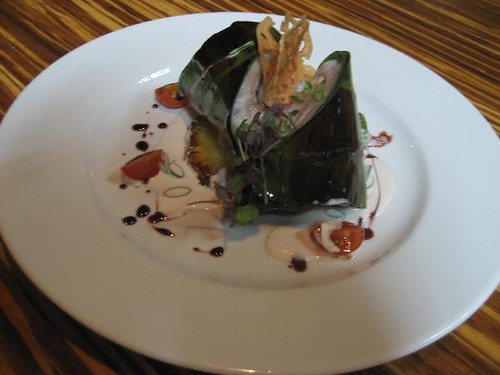
BanQ serves French-Asian fusion cuisine (oo-la-la!). The owners of BanQ, Hemant Chowdhry and Mark Raab, and the chef, Ranveer Brar, were anxious to help Burmese cyclone victims because of the affinity they feel with Burma as the link between the Indian subcontintent (Chowdhry and Brar are Indian) and Southeast Asia. So, they came up with a special dish - spicy halibut wrapped in a banana leaf for which Chef Brar used the Burmese guiding principles of simple food with tropical influences. Proceeds from the dish, which will be on the menu at $26, will go to CARE International.

Why CARE? According to the BanQ newsletter, "Because CARE International has been working for 14 years in Burma (renamed Myanmar by the ruling junta), it has been successful in bypassing the aid backlog and getting immediate help to those affected."

CARE officials report that its 500 workers in the country are focusing on providing clean water and sanitation, distributing rice and high-energy biscuits, and assembling family kits containing blankets, plastic sheeting, clothes and kitchen and hygiene items. CARE will work in coming months to help the Burmese re-establish farming and small businesses."

Sounds like a win-win situation - you can kill two birds with one stone. You order the spicy halibut to satiate your hunger, and the profits are sent to CARE, fulfilling your desire to help but perhaps your lack of an appropriate outlet. There is no reported upper limit to the amount BanQ will donate or how long this dish will be offered - so go often, and enjoy.

For more information about BanQ, read the glowing reviews on Yelp or visit the South End restaurant's website.


Don't forget to vote daily for the Volunteer Boston Blog as the "Best Hobby Blog"!

Related Posts:
Tornadoes, Cyclones, and Disaster Relief - Oh My!; Myanmar cyclones and what you can do to help; Champions of a Cause

Photos courtesy of BanQ.

Thursday, May 22, 2008

Myanmar, Burma, and Celebrities

There's a lot of controversy around celebrities and their pet causes. Some people think celebrities (and the media who covers them) should leave political and social commentary out of the spotlight. Others think celebrities should be doing more to promote their charities of choice.

I happen to be in that first camp - if celebrities are taking the time to think outside of themselves and their hairstyles and what kind of sunglasses they should be seen wearing, and they can get the gossip rags to cover more than their hairstyles, sunglasses, and rehab stints, more power to 'em.

The recent natural disasters have wrought havoc on the developing nations of China and Myanmar (also known as Burma). Hopefully the sun-kissed celebs will start rallying behind fundraising causes for both disasters. Even though Myanmar has been less "accepting" of donations (and press, whose coverage often inspires more donations), the situation there is quite grave on both the disaster front and the human rights front.

Luckily for us, though, prior to this disaster, our friends in tinsel town were already promoting awareness about Myanmar's human rights issues. Various celebrities have helped create videos as part of the Burma: It Can't Wait campaign, which is trying to raise 1 million voices in support of Burma in the month of May.

Some videos are funny (heyyyyy Sarah Silverman and Will Ferrell), others are more serious, like the one below by Ellen Page. Stars of all stripes and sorts from Sylvester Stallone to Jennifer Aniston are taking the time and using their stardom to raise awareness of important issues. And no matter your personal opinion on the matter of Burmese human rights, I think you should give the celebs kudos for standing up for something.


What do you stand for?


Don't forget to vote daily for the Volunteer Boston Blog as the "Best Hobby Blog"!

Related Posts:
Earthquake in China; Global Volunteering; How you can help with a mullet; Tornadoes, Cyclones, and Disaster Relief - Oh My!; Myanmar cyclones and what you can do to help; Champions of a Cause

Photo of the traveling chicken courtesy of Roger_Travels.